The Last Page
Ferguson's Right!
BLOG: “Do you agree with Andrew Ferguson that blogs are self-perpetuating, parasitic news organisms? Explain."
BLOG: “Do you agree with Andrew Ferguson that blogs are self-perpetuating, parasitic news organisms? Explain."
I'm a complete novice to the
blogosphere as I've never written or knowingly read a blog post. I'm so new, in
fact, that I'm going to claim TIME's Joel Stein is my favorite blogger (he's not a
blogger). His Awesome Column would have a witty response to the
question that would make me turn the page to the back cover with a smile on my
face.
Stein occasionally writes
about meeting influential people--most recently Hugh Hefner--and gives humorous insight into a famous person's quirks.
If Stein met Andrew Ferguson and discussed blogs' legitimacy, my opinion
would be clearly laid out in front of me... and there's the problem.
Blogs do more than just
polarize audiences: they try to prove to readers that they share the same
opinion. The "editorial" that Jobs talks about is the clear opinion of the journalist
concerning the news they have gathered. Now, I know news sources try to
convince readers of their views just as much as bloggers, but news-gathering
sources usually write "This is my opinion; let me convince
you," while bloggers tend to type "This is our opinion; here's
why." Like most people, I don't like being told what I think.
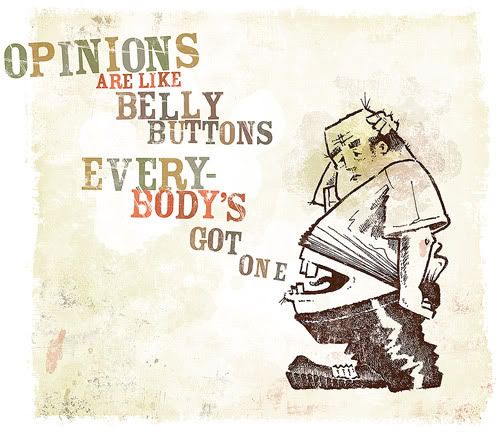 |
| Disclaimer: You're reading my belly button. |
Are they
self-perpetuating? Yeah.
Nobody who regularly and
seriously disagrees with a blogger is going to indefinitely continue to simply
comment their disagreements. The next step would be to start your own blog and
publish your unique viewpoint to the Internet!
Are they parasitic? Yup.
Most bloggers are not reporting first-hand but essentially commenting on news they picked up through news-gathering sources. The worst blogs challenge the editorial through cherry-picking and ad hominem attacks, while the best comment intelligibly on the news, raise concerns, and suggest alternatives.
Most bloggers are not reporting first-hand but essentially commenting on news they picked up through news-gathering sources. The worst blogs challenge the editorial through cherry-picking and ad hominem attacks, while the best comment intelligibly on the news, raise concerns, and suggest alternatives.

Are they news organisms?
Yes.
Ferguson calls the "Times or the Post ... ideological organs as much as news-gathering organs." If these huge organizations are
just organs, then the multitude of blogs can safely be described as microscopic
organisms. The only difference is that the reach and influence of the
blogosphere is much more than the sum of its parts, whereas cellular life forms
rarely have a collective impact.
Though you can't
physically turn the page and set this piece down (my favorite part of reading
print), I can tell you that I agree with Andrew Ferguson's
claim. Hopefully, that satisfies your itch for a conclusive ending.
Multimedia References
"Duty Calls." Xkcd. N.p., 20 Feb. 2008. Web. 12 Sept. 2013. <http://xkcd.com/386/>.
Jeope. "166:
Opinions Are Like Belly Buttons..." Jeopopolis. N.p., 24 Nov. 2008. Web.
13 Sept. 2013. <http://www.jeope.com/2008/11/166-opinions-are-like-belly-buttons.html>.

No comments:
Post a Comment